


Liaison office of Grand Ayatullah Sayyid Ali Al Sistani (L.M.H.L) in London, Europe, North and South America.
- Activities
- 19 Safar 1448
Representative of the Supreme Religious Authority in Europe Praises the Hussaini Rituals, states:
*They are among the most important pillars that have preserved the Muhammadan Islam until this day and will continue to do so until the Day of Judgment.
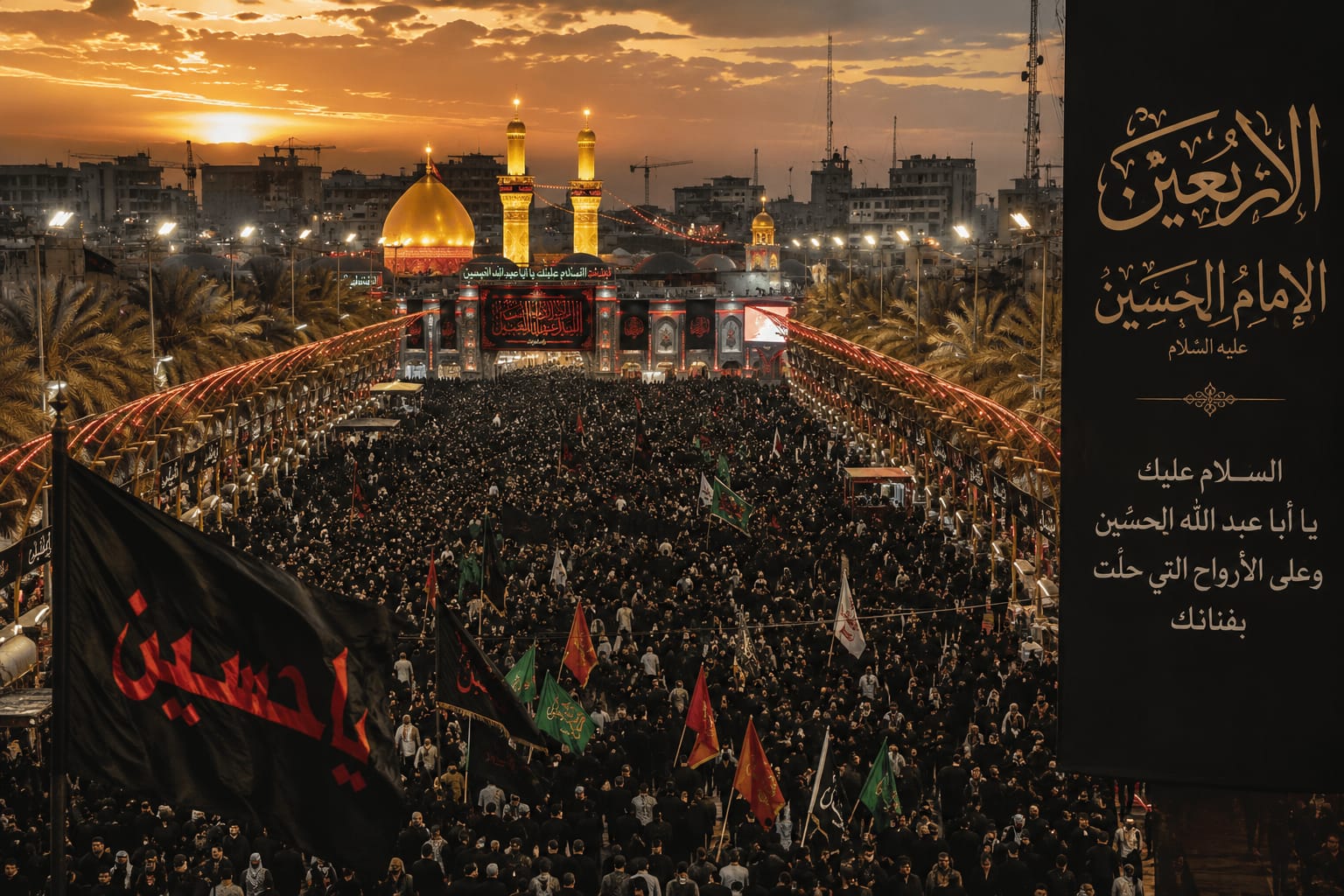
*He criticizes both Arab and Western media for overlooking the millions-strong Arbaeen pilgrimage, despite its attendance exceeding that of the Hajj pilgrimage by more than five times.
These remarks were delivered on the eve of the Arbaeen commemoration of Imam al-Husayn (peace be upon him) in Bucharest, Romania, before a large gathering of Muslims at Al-Zahra Cultural Center. He began by reciting the Qur'anic verse:
"And whoever honors the symbols of Allah—indeed, it is from the piety of hearts." (Qur'an 22:32)
He then said:
Among the greatest manifestations of the Islamic symbols (Sha'a'ir) is the commemoration of the Hussaini gatherings, which have always been—and will continue to be—a beacon for spreading the Muhammadan message throughout the ages. For this reason, the Imams of the Ahl al-Bayt (peace be upon them) consistently emphasized the importance of establishing and reviving these gatherings in every time and place.
Their followers inherited these teachings generation after generation, across different nations and languages. Today, scarcely any part of the world is without communities that commemorate this sacred ritual and disseminate the teachings of the Family of Muhammad (peace be upon them), so that humanity may be enlightened by their knowledge, ethics, and exemplary conduct. This is the secret behind adhering to both the Qur'an and the Ahl al-Bayt, in accordance with the Prophet's (peace and blessings be upon him and his family) saying:
"I leave among you the Book of Allah and my progeny, the people of my household. So long as you hold firmly to both, you shall never go astray after me."
The subjects discussed in these gatherings are nothing more than lessons drawn from the Qur'an—the source of light, guidance, and admonition for humanity:
"This is a clear declaration for mankind, and guidance and instruction for the God-conscious." (Qur'an 3:138)
They also present the lives and moral character of the Pure Household, whose conduct never deviated from that of the prophets, their grandfather the Prophet Muhammad (peace be upon him and his family), or the righteous servants of God. Thus, wherever one finds a preacher addressing a Hussaini gathering—whether in the East or the West—the essence of his message is to guide people toward righteousness and moral integrity.
The second factor behind the continued survival of Shi'ism is the visitation (Ziyarah) of Imam al-Husayn (peace be upon him). The Imams repeatedly encouraged this pilgrimage despite knowing the physical dangers faced by visitors. They supported it through their teachings and supplications, including the famous prayer of Imam Ja'far al-Sadiq (peace be upon him), in which he prayed for the pilgrims who endured hardship, scorching heat, tears, fear, and sacrifice in their journey to visit Imam al-Husayn.
When Mu'awiyah questioned the significance of these visitors, Imam al-Sadiq replied:
"Those who pray for his visitors in the heavens are more numerous than those who pray for them on earth."
From this supplication and the Imam's support for the pilgrimage, it becomes clear that the visitation is not merely a recommended devotional act. Rather, it represents an essential expression of faith, resistance against falsehood, oppression, and tyranny, and embodies one of the central pillars of the Shi'a school—namely, the doctrine of Imamate.
For this reason, the Imams encouraged their followers to continue this practice so they would remain directly connected to the values and ideals represented by Imam al-Husayn. Al-Husayn embodied Islam and the Qur'an itself. Although the Umayyad forces mutilated his body, severed his head, and committed unimaginable atrocities against him, they could never destroy his ideas, beliefs, or principles. Bodies may perish, but principles endure.
It has therefore been said that al-Husayn was truly "reborn" on the day he fell upon the sands of Karbala.
The Messenger may pass away physically,
Yet his message shall never die.
Divine messages continue to shine despite persecution throughout history. The Umayyads imagined that they had silenced al-Husayn by burying him beneath the earth of Karbala. Yet al-Husayn transcended the grave, the land, and even history itself, becoming a universal light whose influence reaches the entire world.
They surrounded Karbala, established checkpoints, and prevented Shi'a from visiting his grave to renew their covenant with him and draw inspiration from his courage and sacrifice. They plowed over the burial site, diverted water across it—giving rise to the area later known as al-Ha'ir al-Husayni—cut down the shade tree under which pilgrims rested, relocated the inhabitants of Karbala, and officially banned the pilgrimage. Nevertheless, people continued to visit.
Unable to stop them physically, opponents attacked the pilgrimage ideologically, claiming that visiting Imam al-Husayn was an innovation (bid'ah), and that every innovation leads to misguidance. They also attempted to inflame sectarian emotions by falsely alleging that Shi'a insult the Prophet's Companions at Imam al-Husayn's grave. Such accusations, he said, are complete fabrications. If, however, some consider figures such as Umar ibn Sa'd, Shimr ibn Dhi al-Jawshan, or Shabath ibn Rib'i—who celebrated Imam al-Husayn's killing—to be among the Prophet's companions, then Muslims and the genuine Companions themselves disassociate from such individuals.
Despite all these dangers and campaigns, believers continued traveling to visit Imam al-Husayn because he remains a universal symbol of righteousness, sacrifice, and freedom for all noble people.
Year after year, this love continues to grow within the hearts of believers, as reflected in the Qur'anic verse:
"Indeed, those who believe and perform righteous deeds—the Most Merciful will appoint for them affection." (Qur'an 19:96)
Likewise, in the Ziyarah prayer it is said:
"He has caused the hearts of the people to incline toward you."
Today resembles yesterday, as millions journey toward Karbala from every corner of the globe—old and young, men and women, children and the elderly—many walking hundreds of kilometers without complaint or fatigue, seeking a direct connection with Imam al-Husayn's principles, values, and message.
It is deeply regrettable, he said, that both Arab and international media largely ignore this unprecedented gathering, despite the fact that the Arbaeen pilgrimage attracts more than five times the number of pilgrims attending the annual Hajj. This event demonstrates the unity and strength of Muslims while conveying a message rejecting oppression, tyranny, and submission to unjust rulers regardless of their identity.
He referred to an article published by *The Independent*, which observed that this religious gathering surpasses even the Kumbh Mela in one respect: while the latter is held once every three years, the Arbaeen pilgrimage takes place annually under severe security threats, representing a profound challenge to terrorism and conveying a universal message of peace and reform.
The article also compared Arbaeen with major international humanitarian efforts. Following the Haiti earthquake, approximately four million meals were distributed through international aid programs, whereas nearly 200 million meals are voluntarily provided during the Arbaeen pilgrimage in Karbala, entirely funded by volunteers and charitable donors.
The author strongly criticized Western media for its politicized treatment of the Hussaini cause, questioning why small demonstrations in London, Hong Kong, or Russia receive extensive coverage while the world's largest peaceful annual gathering—comprising millions of men, women, and children—is largely ignored.
According to the article, this media silence reflects a lack of interest in positive and inspiring stories, particularly those associated with the school of the Ahl al-Bayt. It also notes that anyone walking alongside the pilgrims to Imam al-Husayn encounters countless stories of sacrifice, patience, endurance, generosity, and noble character—stories worthy of major cinematic productions.
The speech concluded with the following verses:
Death has been proven false, for al-Husayn lives forever;
With every passing age, his legacy is renewed.
Imam al-Husayn (peace be upon him) will remain, as long as the world endures, a symbol for all who struggle for justice and freedom, and a light whose radiance shall illuminate the horizons forever.
Peace be upon you, O Aba Abdillah, on the day you were born, the day you were martyred, and the day you shall be raised alive.
×![]()